There's a moment every engineering team has experienced. Someone finds a document on the internal wiki, follows the instructions, and something breaks. They message the channel: "Is this still accurate?" Nobody knows. The person who wrote it left eight months ago. The doc says it was last edited in 2024.
This is the freshness problem. And it's getting worse.
The old contract is breaking down
For a long time, documentation had an implicit contract: someone writes it, everyone trusts it, and occasionally someone updates it. Maybe. That contract worked — barely — when docs were consumed only by people who could apply judgement. If a setup guide looked a bit off, a senior engineer would just adapt on the fly.
But that world is over. Today your documentation isn't just read by humans. It's consumed by AI tools, internal chatbots, onboarding automation, and search systems that treat every word as equivalent truth. An AI assistant doesn't squint at a doc and think "hmm, this looks a bit dated." It reads the text, processes it as fact, and serves it with full confidence.
Stale documentation plus AI equals confidently wrong answers at scale.
What freshness actually means
Freshness isn't just "when was this last edited." A doc could be edited yesterday and still reference a deprecated API. True freshness is a composite signal:
- Review status — has someone explicitly confirmed this is still accurate?
- Link health — are the URLs inside the doc still resolving?
- Readership — is anyone actually using this, or has it been abandoned?
- Contextual drift — have related documents changed while this one stayed the same?
- Translation alignment — if this exists in five languages, are all of them up to date?
- Community signals — have readers flagged this as outdated?
Each of these tells you something different. Together, they give you a trust score: a single number that represents how much confidence you should place in a piece of content right now.
Why this matters now, specifically
Three things have converged to make freshness urgent:
1. AI is consuming your knowledge base
Whether you've deployed an internal RAG system, use Copilot in your IDE, or have an AI assistant answering questions from your docs — the quality of the source material directly determines the quality of the output. Garbage in, garbage out has never been more literal.
When a developer asks your AI assistant "how do I deploy to staging?" and it answers using a two-year-old runbook that references infrastructure you've since migrated, the cost isn't just a wrong answer. It's lost trust in the entire system.
2. Teams are more distributed than ever
A team in Berlin, another in São Paulo, a third in Tokyo. All reading the same documentation, often in different languages. When the English source goes stale, every translation built on top of it goes stale too — but nobody notices because the translations are maintained separately, if at all.
3. Compliance and audit pressure is increasing
Regulated industries are starting to ask: "Can you prove this documentation was current at the time it was referenced?" If your answer is "well, someone probably checked it," that's not going to hold up.
What a freshness-first approach looks like
The core idea is simple: every document must continuously earn the right to be trusted.
This means:
-
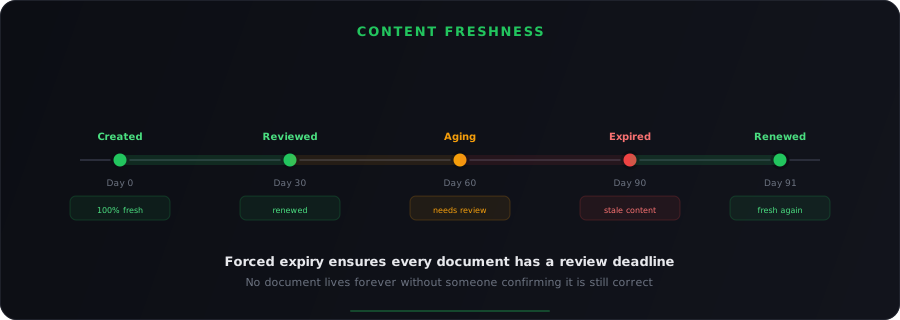
Mandatory review dates. Every document gets an expiry date when it's created. No exceptions. When the date arrives, the owner is notified, and the document is flagged until someone explicitly re-approves it.
-
Automated health monitoring. In the background, the system continuously checks for broken links, readership trends, and contextual changes. These signals feed into a live score that updates without anyone having to do anything.
-
Freshness affects visibility. This is the key mechanism. A high-scoring document surfaces to the top of search results and is eligible to be used as a source for AI answers. A low-scoring document drops in ranking. If it falls below a threshold, it's excluded from AI answers entirely.
-
Transparency. Everyone can see why a document scored the way it did. Broken links, overdue review, low readership — the signals are visible, not hidden in a backend report nobody reads.
The cost of doing nothing
Here's what happens when you don't track freshness:
- New hires follow outdated onboarding docs and spend their first week confused
- AI tools serve wrong answers and nobody understands why
- Compliance docs silently go stale and create audit risk
- Translations drift out of sync and teams in different regions work from different versions of reality
- Engineers stop trusting the wiki entirely and fall back to Slack messages, which creates its own knowledge silo
The compound cost of stale documentation is enormous, but it's invisible until something breaks.
A practical starting point
You don't need to overhaul everything at once. Start with these:
-
Audit your top 20 most-read documents. When were they last reviewed? Are the links still valid? Is the content still accurate?
-
Set review dates. Even if you do nothing else, putting a "review by" date on every document creates accountability.
-
Track what your AI tools are sourcing. If you have an internal AI assistant, look at what documents it's pulling from. Are those documents current?
-
Make freshness visible. Put the score where people can see it — next to the document title, in search results, in the sidebar. Visibility creates pressure to maintain.
Documentation freshness isn't a feature. It's a fundamental shift in how we think about organisational knowledge. In a world where AI tools consume and redistribute your docs at scale, the question isn't whether you can afford to care about freshness. It's whether you can afford not to.
Every document should have to prove it's still worth trusting. Not once — continuously.
That's what we're building at Rasepi. A platform where freshness isn't an afterthought — it's the foundation everything else is built on. Review enforcement, live health scoring, freshness-weighted search, and AI answers that only use sources you can trust.
This is Part 1 of a two-part series. In Part 2: Beyond Expiry Dates, we explore how continuous freshness monitoring fills the gaps that review dates leave open.