Confluence and Notion are not bad products. That needs to be said clearly at the start.
They succeeded for good reasons. Confluence became the default home for internal documentation in many companies because it gave teams a central place to write, organise, and share knowledge. Notion won people over with flexibility, cleaner writing experiences, and a more modern feeling product surface.
Both platforms solved real problems in the era they were built for.
The issue now is that the world around them has changed faster than their foundations.
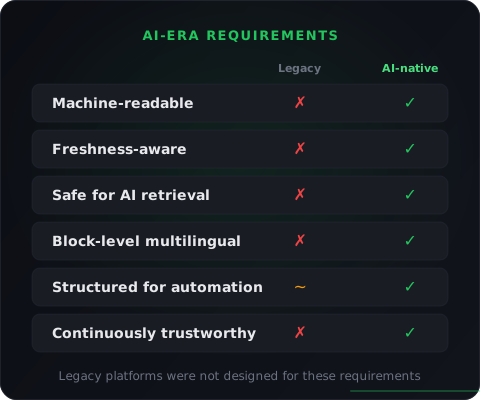
We are no longer in a world where documentation just needs to be written, stored, and searched. We are in a world where documentation is increasingly expected to be:
- machine-readable
- freshness-aware
- safe for AI retrieval
- structured enough for automation
- dynamic across languages and audiences
- continuously trustworthy, not just available
That is a different bar.
They were built for a pre-AI model of knowledge
Traditional documentation platforms were designed around a simple assumption: if the page exists and is searchable, the problem is mostly solved.
That was good enough when the main user was a human opening a wiki, skimming the page, and applying judgement. In that model, the platform's job was to make authoring and navigation easier.
AI changes the job description.
Now the platform is not just storing knowledge for people. It is producing source material for systems that retrieve, rank, summarise, and answer questions automatically.
That introduces new requirements that older architectures did not prioritise:
- Which content is trustworthy right now?
- Which pages are stale but still searchable?
- Which sections changed recently?
- Which language version is current?
- Which content is draft, archived, region-specific, or low-confidence?
- Which documents should be excluded from AI answers entirely?
A platform that was not built around these questions has to retrofit them. That is always harder than designing for them from the start.
Legacy strength becomes legacy drag
Established products have advantages: distribution, ecosystem, brand, customer familiarity, integrations, and teams that know how to ship. But those same strengths can slow structural change.
Why? Because mature platforms carry commitments.
They have:
- years of accumulated product decisions
- huge installed bases with existing workflows
- expectations around backward compatibility
- plugins and extensions depending on old behaviour
- data models optimised for yesterday's use cases
When a platform like Confluence or Notion wants to add a genuinely new capability, it often has to fit that capability around the existing system rather than through it.
That is the challenge of incumbency: you are not just building the future, you are dragging the past with you.
Adding AI features is not the same as becoming AI-native
A lot of established platforms are now layering AI on top. Summaries. Writing assistance. Search improvements. Q&A interfaces. These are useful features. Some of them are good.
But there is a meaningful difference between:
- adding AI features to a documentation product
- building a documentation product whose core architecture assumes AI consumption from day one
The first approach often leads to assistive features around the edges. The second changes the foundation.
An AI-native knowledge platform asks different design questions from the start:
- how should documents be structured so systems can reason about them safely?
- how should trust be represented?
- what metadata must be first-class, not optional?
- how should stale content degrade in visibility?
- how should answers be restricted when the underlying sources are weak?
Those are architectural questions, not feature questions.
Fresh platforms have a temporary advantage
This is where newer platforms can win, at least for a while.
A new platform has the freedom to design around today's constraints instead of yesterday's habits. It does not have to preserve a decade of assumptions about what a document is or how a wiki should behave. It can make different choices early:
- treating freshness as a first-class concept
- making source trust visible to both humans and machines
- storing richer metadata about content state
- building multilingual workflows into the core model instead of bolting them on
- deciding that search and AI retrieval should rank by trust, not just relevance
That freedom matters.
In technology, incumbents are often strongest during stable periods. New entrants are often strongest when the model itself is shifting.
The AI era is one of those shifts.
Why this is especially hard for Confluence
Confluence is powerful, but it comes from an older worldview. It was built around team spaces, pages, hierarchical navigation, and a plugin-rich enterprise model. Those choices made sense. They still make sense for many organisations.
But they also mean the product is carrying a lot of complexity. Enterprise platforms rarely get to reinvent themselves cleanly. They have to negotiate with their own history.
That makes modernisation slower. Not impossible. Just slower.
When AI-era requirements call for cleaner metadata, more explicit trust modeling, or more opinionated content governance, a system built for maximal flexibility through years of extensions can struggle to move cohesively.
Why this is especially tricky for Notion
Notion has a different problem. It feels newer, lighter, and more flexible. But flexibility can also work against it.
Notion's strength is that almost anything can become a page, a database, a note, a lightweight doc, or a collaborative space. That flexibility is great for teams. It is less great when you need strong guarantees about what content means, what state it is in, and whether it should be used as a trusted source by an AI system.
The more free-form a platform is, the harder it is to impose reliable semantics later.
AI systems thrive on structure, explicit metadata, and confidence signals. Flexible general-purpose workspaces often need a lot of interpretation before their content is safe for that kind of use.
None of this means they are doomed
It would be lazy analysis to say Confluence and Notion cannot adapt. Of course they can.
They have smart teams, significant resources, and strong incentives. They will ship more AI capabilities. They will improve retrieval, authoring assistance, summaries, governance, and structured workflows. Over time, they may close a lot of the gap.
But timing matters.
When a shift like this happens, the advantage often belongs to whoever is willing to rebuild assumptions fastest. Newer platforms can move with more coherence because they are not retrofitting as much. That gives them a window.
It may not be a permanent window. But it is real.
The next phase of documentation platforms
The next generation of documentation tools will likely be judged less by how well they let people write pages and more by how well they manage knowledge as a trusted system.
That means the winners will probably do five things well:
- They will model trust explicitly.
- They will distinguish current knowledge from stale knowledge.
- They will handle AI retrieval as a core product surface, not an add-on.
- They will support multilingual and audience-specific knowledge without fragmentation.
- They will give teams stronger control over what information is surfaced, to whom, and under what conditions.
That is a different category from the classic wiki.
Why fresh starts matter
There are moments in software when a clean-sheet product has an advantage not because incumbents are incompetent, but because history is expensive.
This is one of those moments.
A new platform can decide, from day one, that documents are not just pages. They are active sources for humans, agents, search systems, and AI assistants. That assumption changes everything downstream.
Confluence and Notion can get there. But the path is longer because they have to transform systems that were optimised for another era.
That transformation takes time. In the meantime, newer platforms have room to define what modern knowledge infrastructure should look like.
The biggest advantage of a fresh platform is not novelty. It is freedom from old assumptions at exactly the moment those assumptions stop working.