Open your company wiki right now and search for "onboarding." How many results do you get?
If you're a global company, I'm guessing it's not one. It's probably something like this:
Onboarding Guide (EN)Onboarding Guide - GermanyOnboarding Guide - JapanOnboarding LATAM (draft)Onboarding - New (DO NOT USE OLD ONE)
Five documents. All covering roughly the same thing. All slightly different. All maintained by different people on different schedules. Some current, some three months behind, one that nobody is sure about anymore.
This is what happens when your documentation platform can't handle multilingual content properly. You end up copying the whole document for every market, and each copy slowly drifts away from the others.
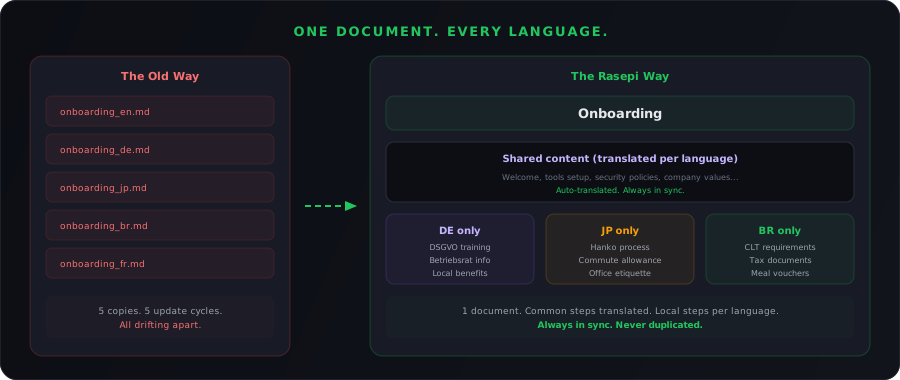
The copy-and-localise trap
It starts innocently enough. You have a great onboarding guide in English. The Berlin office needs it in German, so someone copies it, translates it, and adds the Germany-specific bits: DSGVO training, Betriebsrat information, local health insurance enrollment.
Then Tokyo needs one. Copy again. Translate. Add the Japan-specific stuff: hanko registration, commuter pass process, office etiquette guide.
São Paulo is next. Same thing. Copy, translate, add local content about CLT requirements, meal vouchers, and tax documents.
Now you have four documents. The English original gets updated regularly. The German version was updated last quarter. The Japanese version... someone thinks Tanaka-san updated it in October. The Brazilian version was created by a contractor who left, and nobody has touched it since.
Every copy is a maintenance burden. And every one of them contains a mix of shared content (the stuff that's the same everywhere) and local content (the stuff specific to that market). But the platform doesn't know the difference. It's all just text on a page.
So when someone updates the security policy section in the English original, nobody updates the other four. Or worse, someone updates the German one but not the Japanese one. Now you have five documents that all say slightly different things about the same company policy.
The real problem: shared and local content are mixed together
The thing is, most of these documents are 70-80% identical. The onboarding steps, the tools setup, the security policies, the company values section, the "who to contact" list. That's all the same regardless of whether you're in Berlin, Tokyo, or São Paulo.
The local stuff is maybe 20-30% of the document. Specific compliance requirements, local benefits, regional processes, team contacts for that office.
But when everything lives in one big flat document per language, there's no way to tell which parts are shared and which are local. An update to the shared content means manually checking and updating every copy. Which nobody does consistently. Which is why your copies drift.
One document. That's it.
In Rasepi, the onboarding guide is one document. Not one per language. One.
The shared content, the 70-80% that's the same everywhere, is written once in English and automatically translated into every language your team uses. When someone updates the security policy section in English, it's retranslated in German, Japanese, Portuguese, and French within seconds. No manual copying. No "someone should update the other versions."
The local content lives in its respective language version. The DSGVO training section exists only in the German version. The hanko process exists only in the Japanese version. The CLT requirements exist only in the Portuguese version. These sections are flagged as unique content, they belong to that language and are never overwritten by retranslation.
We covered exactly how this works in our post on how Rasepi translations work. The short version: each paragraph has its own identity. Shared paragraphs are translated and tracked. Unique paragraphs belong to their language and nothing else touches them.
The result? Your wiki search for "onboarding" returns one result. Just "Onboarding." Open it in English, you see the English version with all shared content. Open it in German, you see the same shared content in German plus the Germany-specific sections. Open it in Japanese, same shared content in Japanese plus the Japan-specific sections.
One document. Not five. Not five documents slowly rotting at different speeds.
What this actually changes
This isn't just tidier. It fundamentally changes how your documentation works across offices.
Updates actually reach everyone
When you update the shared part of the onboarding guide, it's updated in every language. Not eventually, not after someone remembers to do it. Automatically. The paragraph you changed is retranslated. Everything else stays exactly where it was.
This means your Tokyo office is reading the same company policy as your London office. Not the version from six months ago that nobody got around to updating.
Local teams own their local content
Your Munich team can add a section about the local gym discount without worrying that it'll get wiped out by the next English update. Their unique content is theirs. It stays in the German version, untouched by any changes to the English source.
Same for every other office. Local content is genuinely local. It doesn't interfere with shared content, and shared content doesn't interfere with it.
New hires get the right information
A new hire in São Paulo opens the onboarding guide and sees everything they need. The shared sections (tools, security, values) are in Portuguese. The Brazil-specific sections (CLT, tax docs, meal vouchers) are right there alongside them. One document, everything in their language, nothing missing, nothing outdated.
They don't need to know that three other offices have different local sections. They just see their version. Clean and complete.
Your page count drops
This is the simple math. If you have 50 key documents and you maintain them in 5 languages with the copy-and-localise approach, you have 250 documents. In Rasepi, you have 50. Each with language versions that share common content and maintain their own local sections.
250 documents to maintain versus 50. That's 200 pages of maintenance overhead that just disappears.
It's not just onboarding
Onboarding is the obvious example because every global company has this problem. But the same pattern shows up everywhere:
- Deployment guides. Core steps are the same, but the Berlin team uses a local staging server and Tokyo has a different approval process.
- Compliance documentation. GDPR section for Europe, LGPD for Brazil, APPI for Japan. All in the same doc, each appearing only where it's relevant.
- Benefits and HR policies. The parental leave policy is different in every country. The company values are the same everywhere.
- Customer-facing help docs. The product works the same everywhere, but payment methods, support hours, and regional regulations vary.
Every one of these is a document that most companies maintain as separate copies per market. And every one of them could be a single document with shared and local content.
The compound effect
Here's where it gets real. A company with 200 documents across 4 markets isn't maintaining 200 docs. They're maintaining 800. But they're staffed for 200. So what actually happens is:
- The English versions are current
- The German versions are mostly current
- The French versions are behind
- The Japanese versions are a question mark
Sound familiar?
In Rasepi, they maintain 200 documents. The shared content is automatically translated. The local content is added by local teams. Every version is as current as the English one, plus whatever local additions the regional team has made.
The translation costs are lower too. When you update one paragraph in English, only that paragraph gets retranslated across all languages. Not the whole document, not all 200 documents. Just the paragraph that actually changed. We wrote about how that works in detail, including the glossary and style rules that make translated content sound natural.
A quick gut check
If you're running a global team, ask yourself:
- How many duplicate documents do you have? Search for the same topic and count the language-specific copies.
- How current are the non-English versions? Check the last-edited date on your German, French, or Japanese docs. How far behind are they?
- Do local teams add content to their versions? Or have they given up because it gets overwritten?
- How long does onboarding take in non-English offices? If it's longer, chances are the documentation isn't serving them properly.
If the answers make you uncomfortable, you're not alone. Most companies don't realise how much overhead they've created until they actually count the copies.
Documentation should scale with your company, not multiply. Every copy you maintain is a copy that can fall behind, confuse a new hire, or contradict the version someone else is reading. One document per topic, with shared content translated and local content where it belongs, is how documentation should work in a global company.
Your wiki shouldn't need five copies of the same document. One is enough. Shared steps translated, local steps per language. That's it.